This post contains affiliate links. We may earn a small commission when you purchase through our links, at no extra cost to you. We only share items that align with our vision of a calm and intentional home.
The most common kitchen problem is not a lack of space. It is a lack of system. Dry goods end up in whatever cabinet had room when you came home from the grocery store. Spices are sorted by the order they arrived, not by how often you use them. The drawer closest to the stove has become a catch-all for things that had no obvious home. These are kitchen organization problems and most of them are solvable without a renovation or a full weekend of work.
This guide covers 25 kitchen organization ideas for pantry storage, counter setup, drawers, cabinets, small kitchen storage, and fridge organization. Where a product makes a solution easier to maintain, you will find a practical recommendation. Every tip is designed to be simple enough to set up in a few hours and practical enough to keep working without constant effort. Most of them also double as useful hooks for a more organized kitchen in general, from pantry organization and cabinet organization to small kitchen storage ideas that work even when space is genuinely limited.
Jump to a section:
– Pantry and Shelf Organization
– Counter Organization
– Drawer Organization
– Cabinet Organization
– Small Kitchen Organization
– Fridge Organization
– The Product Edit
Pantry and Shelf Organization
1. Decant dry goods into uniform containers
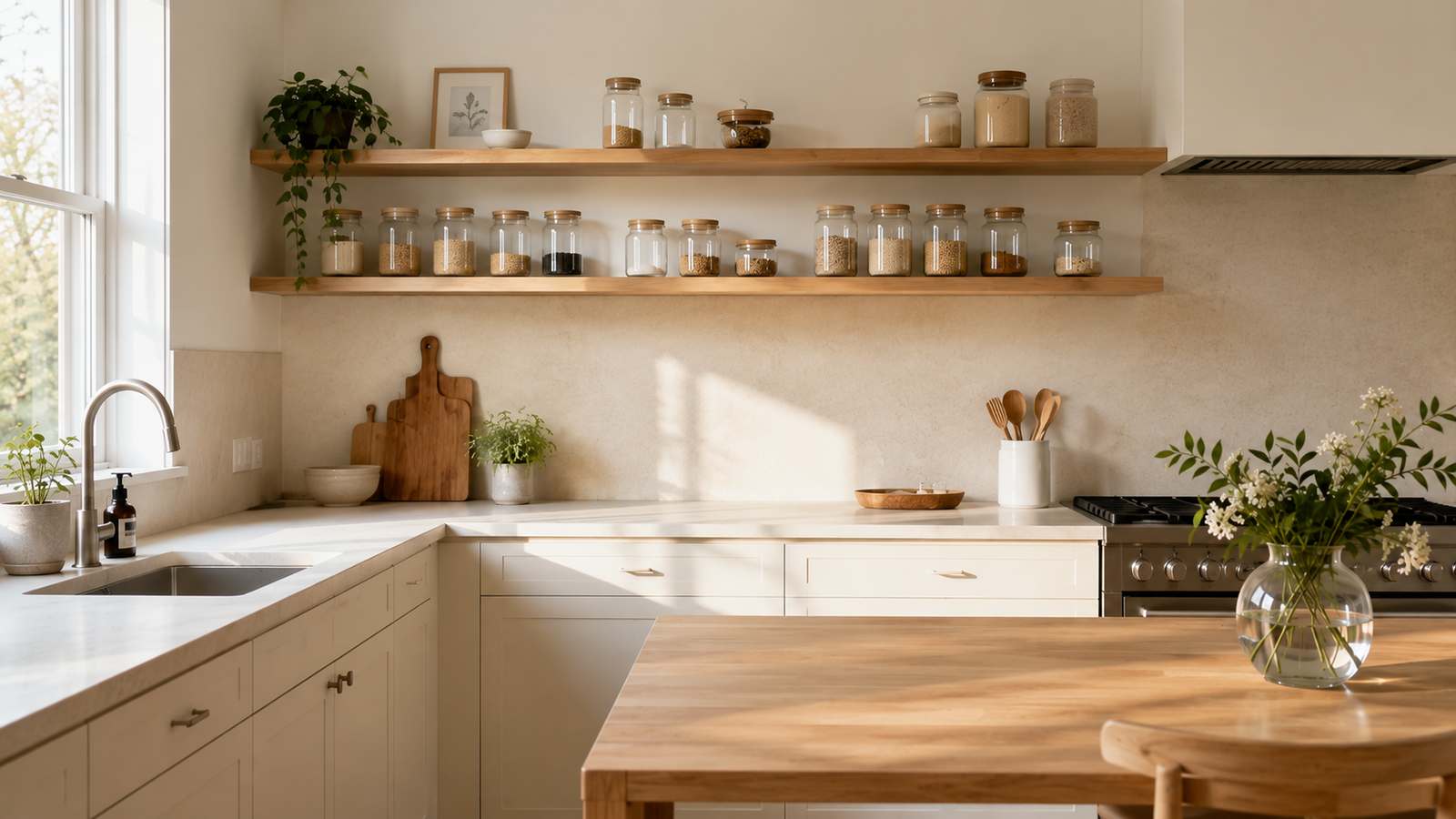
Pasta, rice, oats, lentils, and flour in their original packaging, with different sizes, shapes, and label designs, make a shelf harder to read than it needs to be. Transferring them into matching glass or airtight containers means you can see what you have, how much is left, and what needs restocking in one glance.
A practical rule: once a container reaches about one-third full, move it to the front of the shelf so it gets used before you open the next one. This alone reduces the habit of buying things you already have.
Shop the solution:
- Glass Storage Jars with Bamboo Lids
- Why we love it: airtight, stackable, available in sets large enough to do the whole pantry at once.
- View on Amazon
2. Transfer spices into matching glass jars
Most spice problems come down to one thing: you cannot see what you have. Jars get pushed to the back, stacked on top of each other, or lost in a cabinet that requires moving several other things to reach them. Transferring your spices into matching glass jars with labels means every jar is immediately readable, and the shelf stays consistent enough to remain organized.
Once the jars match, you stop buying duplicates. You can see at a glance that the cumin is almost empty before you start cooking.
Shop the solution:
- Glass Spice Jars with Labels
- Why we love it: uniform size, airtight, with prewritten and blank labels included.
- View on Amazon
3. Add a rotating pantry organizer to corner shelves and deep cabinets
Corner shelves and deep cabinets share the same problem: things slide to the back and stay there. Oils, vinegars, sauces, and supplements end up invisible and eventually expire unused. A rotating organizer brings everything forward with one turn and makes the full depth of the shelf usable.
This works on pantry shelves, inside lower cabinets, and inside the fridge. It is one of the most versatile small kitchen storage solutions available.
Shop the solution:
- Rotating Pantry Organizer
- Why we love it: available in multiple sizes for shelves, cabinets, and fridge use.
- View on Amazon
4. Use shelf risers to double vertical pantry space
Standard pantry shelves waste a significant amount of vertical space. A shelf riser sits on top of an existing shelf and creates a second level, letting you store canned goods, jars, or boxes in two rows where one used to fit.
A useful setup for canned goods: front row is the current supply, back row is backstock. Restocking means sliding a can forward. No reorganization needed.
Shop the solution:
- Stackable Shelf Risers
- Why we love it: Adjustable width, no tools required, works on most standard shelving.
- View on Amazon
5. Create a dedicated backstock zone
Most pantry confusion happens because open and unopened products are mixed together on the same shelf. You buy another bottle of olive oil without realizing you already had one, or you open a second box of pasta because the first was hidden behind something else.
A dedicated backstock section, with one shelf or one bin specifically for unopened duplicates, fixes this without requiring anyone to actively manage it. Label the zone clearly. When something gets opened, the replacement moves to the front.
6. Set up an “eat first” section
Designate one shelf or one bin in the pantry for items that are close to their use by date, leftover ingredients from a recipe, or anything that should be used before you open something new.
It takes about five minutes to set up and reduces both food waste and the habit of buying things you already own but could not find. The key is keeping it small enough that it stays visible. A large “eat first” section becomes its own clutter problem.
Counter Organization
7. Set up a dedicated coffee or breakfast station
A coffee station works because it groups everything you reach for at the same time, including the machine, the grinder, the beans, the mugs, and the sugar, in one area. You stop moving between cabinets and counters in the morning, and the area around the machine stays contained because every item has a fixed place to return to.
The same logic applies to a breakfast station: a small section of counter near the toaster, with bread, spreads, and the items you reach for every morning. One area, everything in one place.
Shop the solution:
- Ceramic Kitchen Canister Set
- Why we love it: keeps coffee, sugar, and dry staples within reach without loose packaging taking up counter space.
- View on Amazon
8. Use a woven storage basket for produce and bulky items
Not everything on a counter belongs in a drawer or a cabinet. Onions, potatoes, fruit, and loose snacks need space and air, and they look cluttered without a defined spot. A woven basket gives these bulkier items a home that does not look improvised.
It also contains the visual noise. One basket with produce reads as intentional. The same items sitting loose on a counter do not.
Shop the solution:
- Woven Storage Basket
- Why we love it: use it for produce, snacks, or anything that needs space and air, like onions, potatoes, or fruit. A basket gives bulkier items a home that does not look improvised.
- View on Amazon
9. Organize the sink area with a sponge holder
The area around the kitchen sink is used many times a day and frequently ends up with multiple different bottles, a wet sponge sitting on the edge, and a dish brush without a home. Keeping the sponge in a small caddy moves both off the counter surface and makes the area much easier to clean.
Shop the solution:
- Sponge Holder Set
- Why we love it: keeps the sink area contained and the counter easier to wipe down.
- View on Amazon
10. Apply a daily-use rule for countertop appliances
The most reliable way to stop counter clutter from returning is one simple rule: if you do not use it every day, it does not stay on the counter. The blender, the air fryer, and the bread maker are appliances used occasionally, so they earn cabinet or pantry space instead of permanent counter space.
The working surface you actually cook on should be clear enough to use without moving anything first.
Drawer Organization
11. Install bamboo drawer dividers in every kitchen drawer
An organized kitchen drawer and a disorganized one often contain exactly the same items. The difference is whether those items have defined slots. Without dividers, everything migrates into everything else within days. With adjustable dividers, each tool or utensil has a fixed place, and putting it back is as easy as taking it out.
Start with the drawer closest to where you cook. That is the one that gets used most and resets hardest.
Shop the solution:
- Adjustable Bamboo Drawer Dividers
- Why we love it: expandable to fit most standard drawer widths.
- View on Amazon
12. Mount a magnetic knife strip on the wall
Knives stored loose in a drawer dull faster, are harder to grab quickly, and use up drawer space disproportionate to their size. A magnetic strip mounted on the wall or the side of a cabinet keeps knives accessible, lets them dry properly after washing, and frees that drawer for other tools.
Shop the solution:
- Magnetic Knife Strip
- Why we love it: wall-mounted, holds knives without a block or drawer.
- View on Amazon
13. Use vertical dividers for baking sheets, cutting boards, and pan lids
Flat items stacked horizontally require removing the whole pile to reach the one at the bottom. Baking sheets, cutting boards, and pan lids are the most common examples. A vertical divider, whether placed in a deep drawer or inside a lower cabinet, stores them upright and individually accessible.
Grabbing a cutting board or a sheet pan becomes a single movement.
Shop the solution:
- Vertical Baking Sheet and Cutting Board Organizer
- Why we love it: fits most lower cabinets, keeps flat items separated and upright.
- View on Amazon
14. Give the utility drawer a simple organizer tray
Every kitchen has one: the drawer that holds batteries, scissors, tape, a random screwdriver, and things that have no other home. This drawer is not a problem to eliminate. It is a reality to manage. An organizer tray inside it means useful items stay findable. Keep the tray smaller than the drawer so there is a limit to what fits. This makes it easier to clear out periodically.
Cabinet Organization
15. Use pull-out organizers for lower cabinet pots and pans
Deep lower cabinets are one of the most common kitchen frustrations. The pot you need is always at the back, which means you have to remove several other items to reach it. Sliding organizers, whether installed drawer systems or freestanding racks, bring the full depth of the cabinet forward and make every pot and pan individually accessible.
Shop the solution:
- Pull-Out Cabinet Organizer
- View on Amazon: freestanding versions require no installation and fit most standard lower cabinets.
- View on Amazon
16. Store pot lids vertically in a dedicated rack
Pot lids do not stack cleanly with pots, they slide off each other, and they take up space in a shape that does not match any standard shelf. A vertical rack with dividers stores all lids upright and sorted by size, so grabbing the right one takes a second instead of reorganizing the whole cabinet.
Shop the solution:
- Pot Lid Organizer Rack
- Why we love it: freestanding, no installation, fits most lid sizes.
- View on Amazon
17. Use a food container organizer for storage boxes and lids
A loose pile of mismatched food containers and lids in a cabinet is a problem in most kitchens. A vertical organizer fixes it. Containers sit in slots sorted by size, while lids are stored separately and sorted by size. Matching a container to a lid takes a few seconds, and putting them away is straightforward enough that the system stays organized.
Shop the solution:
- Food Container and Lid Organizer
- Why we love it: vertical slots for containers, separate lid storage, adjustable dividers.
- View on Amazon
18. Organize under the sink with bins and a rotating shelf
The space under the kitchen sink tends to collect cleaning products, spare bags, and items placed there temporarily and never moved. The main problem is that items get pushed to the back where they become hard to see and easy to forget.
Clear bins grouped by type, with one for cleaning sprays, one for spare sponges, and one for bin liners, keep similar items together. An adjustable shelf or small lazy Susan in the center makes the full depth of the cabinet usable around the pipe.
Shop the solution:
- Under Sink Organizer with Adjustable Shelves
- Why we love it: works around the pipe, adds a second level of storage.
- View on Amazon
19. Add an over-the-door organizer to pantry and cabinet doors
The inside of a pantry door or a large cabinet door is storage space that most kitchens leave empty. A rack that hangs on the door holds spices, small bottles, wraps and foils, or cleaning supplies, while adding an extra layer of accessible storage without using shelf or counter space. For a pantry door, this is often enough to free up an entire shelf inside the pantry.
Shop the solution:
- Over-the-Door Pantry Organizer
- Why we love it: fits most standard doors, adjustable shelves, no tools required.
- View on Amazon
Small Kitchen Organization
20. Hang frequently used tools on a kitchen rail or pegboard
In a small kitchen where cabinet space is genuinely limited, a wall-mounted rail or pegboard near the cooking area holds pots, pans, and utensils in a way that frees up drawer and cabinet space. Every item is visible and within reach during cooking, which also makes the process of cooking faster.
A pegboard is the most flexible option because the hooks can be repositioned as your storage needs change.
Shop the solution:
- Wall-Mounted Kitchen Rail with Hooks
- Why we love it: holds pots, pans, and utensils above the cooking area, stainless steel.
- View on Amazon
21. Create an appliance zone instead of storing everything on the counter
Most appliances live on the counter because there was no clear plan for where else they would go. A more functional approach: identify which appliances you use daily and which you use occasionally.
Appliances you use every day, such as a coffee maker or toaster, earn a fixed counter spot. Appliances used occasionally earn a shelf, a lower cabinet, or an appliance garage if you have one.
An appliance garage is a closed section of cabinetry at counter height with a rolling or folding door. It keeps appliances accessible without them permanently taking up surface space.
22. Set up a snack zone or grab-and-go station
A dedicated snack zone works well in any household where the same few items get reached for multiple times a day. Group snacks, portable packaging, and grab-and-go food in one bin or on one shelf at a practical height. This reduces the number of times the whole pantry gets searched for the same items, which also helps it stay organized between resets.
Fridge Organization
23. Use clear bins to create zones in the fridge
An unorganized fridge is almost always a zoning problem. Without defined areas, leftovers end up next to condiments, fresh vegetables get pushed behind takeout containers, and ingredients for the same meal are scattered across three shelves. Clear bins create visible zones: one for dairy, one for meal prep, one for snacks, one for leftovers. Items return to their zone after each use.
Label the bins. A label turns a personal system into a household system that anyone can follow.
Shop the solution:
- Clear Fridge Organizer Bins
- Why we love it: stackable, easy to clean, available in sets with multiple sizes.
- View on Amazon
24. Add a rotating shelf to the fridge for condiments and sauces
Condiments and sauces pushed toward the back of a fridge shelf become invisible and stay there until they expire. A small rotating shelf on one fridge level brings everything forward with one turn. This works especially well on door shelves where tall bottles block shorter jars.
Shop the solution:
- Fridge rotating shelf
- Why we love it: compact, fits most fridge shelf depths, easy to wipe clean.
- View on Amazon
25. Create an “eat first” section for leftovers and meal prep
Designate one shelf, ideally at eye level, specifically for food that should be used before anything else: leftovers, open packages, and meal prep containers for the current week. When this section is visible and clearly labeled, food gets used instead of forgotten at the back.
A small “eat first” label on the shelf or bin makes the system easy for everyone in the household to follow without explanation.
The Final Thought
Most kitchen organization systems fail not because they were set up wrong, but because resetting them takes too long. The ideas in this guide work best when each one is simple enough to maintain in under a minute. Start with the area that frustrates you most, whether that is the spice shelf, the junk drawer, or the cabinet under the sink, and get that one area working before moving to the next
For more organization ideas by room: explore the full fridge organization guide for zones, bins, and weekly meal prep setup. Or read the bathroom organization guide if the bathroom counter is next on the list.